
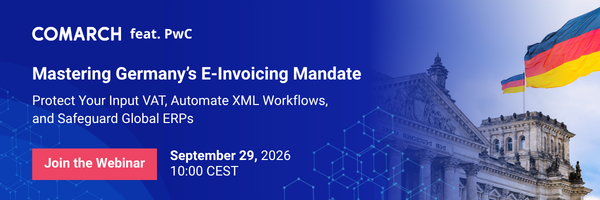
WEBINAR | Mastering Germany’s E-Invoicing Mandate feat. PwC, 29.09.2026, 10:00

  • 15.09.2026
  • PwC Advisory Spółka z ograniczoną odpowiedzialnością sp.k.
  • ul. Polna 11
  • 00-633 Warszawa
  • PL
Szczegóły

Protect Your Input VAT, Automate XML Workflows, and Safeguard Global ERPs Why is e-invoicing in Germany so different? Why isn't there one official format? Where does PEPPOL fit in – and can you still send an e-invoice by email?
report image
Germany's e-invoicing mandate is no longer a future IT project – it's an active compliance reality, and for companies with German legal entities and cross-border supply chains, the rules of engagement have changed.Accept an inbound invoice with syntax errors, incorrect master data, or an unsupported format, and you risk losing your right to claim input VAT deductions.Meanwhile, international ERP systems are struggling to interpret all versions of XRechnung or ZUGFeRD formats, leaving accounts payable teams drowning in unreadable XML data and facing severe GoBD archiving violations.

You Will Learn How to
  • Build a compliant e-invoicing strategy: understand legal, business, process, and technical requirements before implementation begins
  • Stop the input VAT trap: set up automated validations that catch and reject non-compliant supplier data before it reaches your ledger
  • Bridge the ERP gap: connect global platforms (SAP, Oracle, NetSuite) to German mandates without costly, disruptive upgrades
  • Fix AP/AR chaos: turn raw machine code into human-readable layouts for faster approvals
  • Audit-proof your archive: master the strict GoBD requirements for storing raw XML data for 10 years
  • Onboard suppliers fast: manage vendor transitions smoothly, without supply chain friction
Registration and more: WEBINAR | Mastering Germany’s E-Invoicing Mandate feat. PwC | Comarch
  • PwC Advisory Spółka z ograniczoną odpowiedzialnością sp.k.
  • ul. Polna 11
  • 00-633 Warszawa
  • PL

Pozostałe notatki

Webinar: Qualified domestic top-up tax (QDMTT) in Poland – compliance obligations and safe harbours, 01.10.2026, godz. 10:00-11:00

  • 08.09.2026

The Qualified Domestic Minimum Top-up Tax (QDMTT), introduced in Poland as part of the OECD Pillar Two framework and the global minimum tax regime, brings new compliance and reporting obligations for groups with consolidated revenues exceeding €750 million. As organisations prepare for their first Pillar Two reporting cycle, understanding the applicable rules, safe harbours and top-up tax requirements has become a key priority for tax and finance teams.

Webinarium: Marketing Mix Modeling. Jak mierzyć skuteczność marketingu w erze AI?, 16.09.2026, godz. 09:00-10:30

  • 07.09.2026

Data i czas: 16 września 2026 r., godz. 09:00 - 10:30. AI w marketingu 2026: od hype'u do P&L . Marketing ma dziś więcej danych niż kiedykolwiek, ale coraz trudniej ocenić, które działania realnie przekładają się na sprzedaż. Jednocześnie rozwój AI, automatyzacji, personalizacji oraz zmiany w obszarze cookies i platform cyfrowych sprawiają, że pomiar efektywności marketingu staje się jeszcze większym wyzwaniem.

Webinarium: NIS2 - ostatni dzwonek, 11.09.2026, godz. 10:00-13:00

  • 07.09.2026

Data i czas: 11 września 2026 r., 09:30 - 11:00. Zapraszamy na praktyczne webinarium poświęcone dyrektywie NIS2, która wprowadza nowe wymagania w zakresie cyberbezpieczeństwa w Unii Europejskiej, w tym w Polsce. Omówimy, kto i w jaki sposób powinien dokonać samoidentyfikacji oraz złożyć wniosek o wpis do wykazu podmiotów kluczowych i ważnych – termin upływa już 3 października 2026 roku.

Webinarium: Od regulacji do odporności biznesu: produkty i łańcuchy dostaw. Praktyczny przewodnik po zmianach regulacyjnych, 08.09.2026, godz. 10:00 - 11:30

  • 07.09.2026

Data i czas: 8 września 2026 r., godz. 10:00 - 11:30. Zapraszamy na webinar, podczas którego pokażemy, jak regulacje będą kształtować otoczenie biznesowe w latach 2026-2028 oraz jak w praktyce przełożyć nowe wymagania na większą efektywność, odporność i przewagę konkurencyjną firmy.